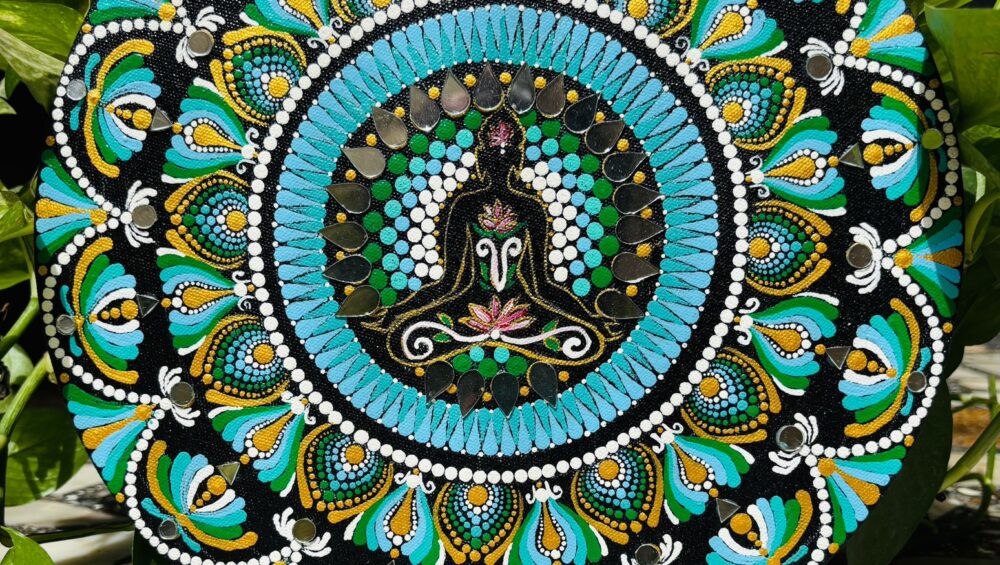
We have forgotten how to listen to what does not speak out loud in a world full with words, pictures, and incessant noise. Humans used simple, intentional, and deep markings to communicate long before alphabets, scripts, and displays. Circles and dots. Quiet. Subtle but potent, this old visual language is still present on the periphery of our consciousness, just waiting to be recalled.
The Dot: The Beginning of Meaning
Despite being the smallest mark, the dot has a great deal of weight. It has represented origin, presence, and consciousness in many civilizations. The center of existence, where everything originates, is represented by a dot in many indigenous traditions. Before creation, it is the breath and the seed.
According to Indian philosophy, the bindu is the place where form, space, and time all vanish into pure potential. Dots map ancestry, geography, and stories to create complete cosmologies in Aboriginal art. A single dot is a statement that something is present and is never only decorative.
The Circle: Wholeness Without Words
The circle represents continuity if the dot represents the start. The circle, which has no beginning or end, represents cycles, including life, death, rebirth, seasons, and breath. In order to coordinate with the universe rather than to explain it, ancient tribes created circles in sand, carved them into stone, and erected monuments around them.
Mandalas, medicine wheels, halos, and ceremonial areas all have circles. They link, confine, and safeguard. Circles imply return, whereas straight lines imply direction and advancement. They serve as a reminder that finding meaning sometimes involves returning to oneself, the natural world, and quiet.
Silence: The Space Between Symbols
Silence may be the most overlooked language of all. It’s presence without sound, not absence. Symbols may breathe when there is silence. A dot is invisible in the absence of silence, while a circle turns into noise in the absence of stillness.
Why We Forgot
Certainty, explanation, and speed are important in today’s world. We are taught to inquire about the meaning of this. rather than how this makes me feel. It is difficult to convert the language of dots and circles into words. It calls for presence, patience, and intuition—skills we have overlooked.
Technology lowered our perception while amplifying our voices. Symbols evolved into aesthetics. Absence replaced silence. The sacred turned into a decorative element.
Remembering the Language
Remembering this lost language means balancing words rather than giving them up. It is to acknowledge that meaning can exist even in the absence of explanation. A moment of stillness, a circle sketched in dust, or a dot on a canvas are not incomplete messages. They are comprehensive encounters.
Mindful observation, meditation, and art are ways to return to this language. The symbols start to speak again when we slow down and give ourselves permission to sit simply—not in words, but in feelings.
The language of circles, dots, and stillness was merely disregarded rather than completely forgotten. It can be found in the patterns seen in nature, in historical artwork, and in the silent moments we pass quickly. It takes attention, humility, and silence in addition to intelligence to decipher it.